SelfDefinition.Org
Sutra Spoken By The Sixth Patriarch
On the High Seat of the Treasure of the Law
Hui Neng
This section needs work. Sorry.
Christmas Humphreys Edition (1952)
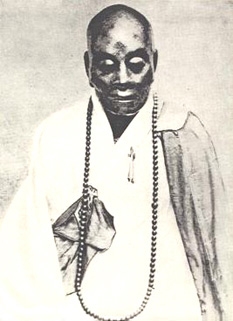
I Autobiography of Hui Neng
Once, when the Patriarch had arrived at Pao Lam Monastery, Prefect Wai of Shiu Chow and other officials went there to ask him to deliver public lectures on Buddhism in the hall of Tai Fan Temple in the City (of Canton). [Guangzhou]
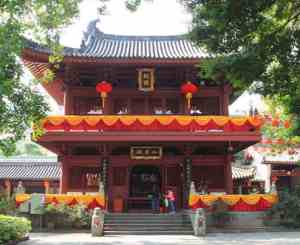
Tai-fan Temple Guangxiao Temple (Guangzhou)
In due course, there were assembled (in the lecture hall) Prefect Wai, government officials and Confucian scholars, about thirty each, and Bhikkhus, Bhikkhunis, Taoists and laymen, to the number of about one thousand. After the Patriarch had taken his seat, the congregation in a body paid him homage and asked him to preach on the fundamental laws of Buddhism. Whereupon, His Holiness delivered the following address:—
Learned Audience, our Essence of Mind (literally, self-nature) which is the seed or kernel of enlightenment (Bodhi) is pure by nature, and by making use of this mind alone we can reach Buddhahood direcdy. Now let me tell you something about my own life and how I came into possession of the esoteric teaching of the Dhyana (or the Zen) School.
My father, a native of Fan Yang, Was dismissed from his official post and banished to be a commoner in Sun Chow in KLwangtung. I was unlucky in that my father died when I was very young, leaving my mother poor and miserable.
Wc moved to Kwang Chow (Canton) and were then in very bad circumstances.
I was selling firewood in the market one day, when one of my customers ordered some to be brought to his shop. Upon delivery being made and payment received, I left the shop, outside of which I found a man reciting a Sutra. As soon as I heard the text, of this Sutra my mind at once became enlightened. Thereupon I asked the man the name of the book he was reciting and was told that it was the Diamond Sutra (Vajracchedika or Diamond Cutter). I further enquired whence he came and why he recited this particular Sutra. He replied that he came from Tung Tsan Monastery in the Wong Mui District of Kee Chow; that the Abbot in charge of this temple was Hwang Yan, the Fifth Patriarch; that there were about one thousand disciples under him; and that when he went there to pay homage to the Patriarch, he attended lectures on this Sutra. He further told me that His Holiness used to encourage the laity as well as the monks to recite this scripture, as by doing so they might realise their own Essence of Mind, and thereby reach Buddahood directly.
It must be due to my good karma in past lives that I heard about this, and that I was given ten taels for the maintenance of my mother by a man who advised me to go to Wong Mui to interview the Fifth Patriarch. After arrangements had been made for her, I left for Wong Mui, which took me less than thirty days to reach.
I then went to pay homage to the Patriarch, and was asked where I came from and what I expected to get from him. I replied, "I am a commoner from Sun Chow of Kwangtung. I have travelled far to pay you respect and I ask for nothing but Buddhahood." "You are a native of Kwangtung, a barbarian? How can you expect to be a Buddha?" asked the Patriarch. I replied, "Although there are northern men and southern men, north and south make no different to their Buddha-nature. A barbarian is different from Your Holiness physically, but there is no difference in our Buddha-nature." He was going to speak further to me, but the presence of other disciples made him stop short. He then ordered me to join the crowd to work.
"May I tell Your Holiness," said I, "that Prajna (transcendental Wisdom) often rises in my mind. When one does not go astray from one's own Essence of Mind, one may be called the 'field of merits.'** I do not know what work Your Holiness would ask me to do?"
A title of honour given to monks, as they afford the best opportunities to others to sow the ' seed ' of merits.
"This barbarian is too bright," he remarked. "Go to the stable and speak no more." I then withdrew myself to the backyard and was told by a lay brother to split firewood and to pound rice.
More than eight months after, the Patriarch saw me one day and said, "I know your knowledge of Buddhism is very sound; but I have to refrain from speaking to you, lest evil doers should do you harm. Do you understand?" "Yes Sir, I do," I replied. "To avoid people taking notice of me, I dare not go near your hall."
The Patriarch one day assembled all his disciples and said to them, "The question of incessant rebirth is a momentous one. Day after day, instead of trying to free yourselves from this bitter sea of lire and death, you seem to go after tainted merits only (merits which will cause rebirth). Yet merits will be or no help, if your Essence of Mind is obscured. Go and seek for Prajna (wisdom) in your own mind and then write me a stanza (gatha) about it. He who understands what the Essence of Mind is will be given the robe (the insignia of the Patriarchate) and the Dharma (i.e., the esoteric teaching of the Dhyana School), and 1 shall make him the Sixth Patriarch. Go away quickly. Delay not in writing the stanza, as deliberation is quite unnecessary and of no use. The man who has realised the Essence of Mind can speak of it at once, as soon as he is spoken to about it; and he cannot lose sight of it, even when engaged in battle."
Having received this instruction, the disciples withdrew and said to one another, "It is of no use for us to concentrate our mind to write the stanza and submit it to His Holiness, since the Patriarchate is bound to be won by Shin Shau, our instructor. And if we write perfunctorily, it will only be a waste of energy." Upon hearing this, all of them made up their minds not to write and said, "Why should we take the trouble? Hereafter, we will simply follow our instructor, Shin Shau, wherever he goes, and look to him for guidance."
Meanwhile, Shin Shau reasoned thus with himself. "Considering that I am their teacher, none of them will take part in the competition. I wonder whether I should write stanza and submit it to His Holiness. If I do not, how can the Patriarch know how deep or superficial my knowledge is? If my object is to get the Dnarma, my motive is a pure one. If I were after the Patriarchate, then it would be bad. In that case, my mind would be that of a worldling and my action woula amount to robbing the Patriarch's holy seat. But if I do not submit the stanza, I shall never have a chance of getting the Dharma. A very difficult point to decide, indeed!"
In front of the Patriarch's hall there were three corridors, the walls of which were to be painted by a court artist, named Lo Chun, with pictures from the Lankavatara (Sutra) depicting the transfiguration of the assembly, and with scenes showing the genealogy of the five Patriarchs for the information and veneration of the public.
When Shin Shau had composed his stanza he made several attempts to submit it to the Patriarch; but as soon as he went near the hall his mind was so perturbed that he sweated all over. He could not screw up courage to submit it, although in the course of four days he made altogether thirteen attempts to do so.
Then he suggested to himself, "It would be better for me to write it on the wall of the corridor and let the Patriarch see it for himself. If he approves it, I shall come out to pay homage, and tell him that it is done by me; but if he disapproves it, then I shall have wasted several years in this mountain in receiving homage from others which I by no means deserve! In that case, what progress have I made in learning Buddhism?"
At 12 o'clock that night he went secretly with a lamp to write the stanza on the wall of the south corridor, so that the Patriarch might know what spiritual insight he had attained. The stanza read:—
"Our body is the Bodhi-tree,
And our mind a mirror bright.
Carefully we wipe them hour by hour,
And let no dust alight."
As soon as he had written it he left at once for his room; so nobody knew what he had done. In his room he again pondered: "When the Patriarch sees my stanza to-morrow and is pleased with it, I shall be ready for the Dharma; but if he says that it is badly done, it will mean that I am unfit for the Dharma, owing to the misdeeds in previous lives which thickly becloud my mind. It is difficult to know what the Patriarch, will say about it!" In this vein he kept on thinking until dawn, as he could neither sleep nor sit at ease.
But the Patriarch knew already that Shin Shau had not entered the door of enlightenment, and that he had not known the Essence of Mind.
In the morning, he sent for Mr. Lo, the court artist, and went with him to the south corridor to have the walls there painted with pictures. By chance, he saw the stanza. "I am sorry to have troubled you to come so far," he said to the artist. "The walls need not be painted now, as the Sutra says, 'All forms or phenomena are transient and illusive.' It will be better to leave the stanza here, so that people may study it and recite it. If they put its teaching into actual practice, they will be saved from the misery of being born in these evil realms of existence (gatis). The merit gained by one who practises it will be great indeed!"
He then ordered incense to be burnt, and all his disciples to pay homage to it and to recite it, so that they might realise the Essence of Mind. After they had recited it, all of them exclaimed, "Well done!"
At midnight, the Patriarch sent for Shin Shau to come to the hall and asked him whether the stanza was written by him or not.
"It was, Sir," replied Shin Shau. "I dare not be so vain as to expect to get the Patriarchate, but I wish Your Holiness would kindly tell me whether my stanza shows the least grain of wisdom."
"Your stanza," replied the Patriarch, "shows that you have not yet realised the Essence of Mind. So far you have reached the 'door of enlightenment,' but you have not yet entered it. To seek for supreme enlightenment with such an understanding as yours can hardly be successful.
MISSING MISSING MISSING
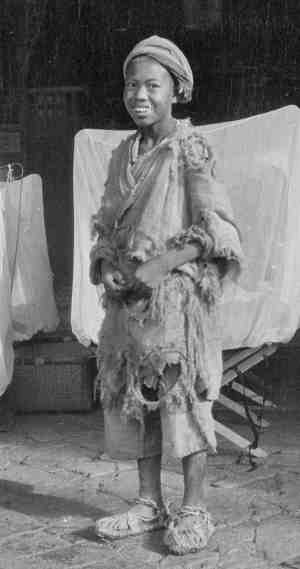
Aboriginal Chinese Boy
"MISSING MISSING MISSING "
-- A LOT missing here --
autobiography
would mean two ways," I replied. "And there cannot be two ways in Buddhism. There is one way only!
He asked what was the only way. I replied, "The Maha Parinirvana Sutra which you expound explains that Buddha-nature is the only way. For example, in that Sutra King Ko Kwai.Tak, a Bodhisattva, asked Buddha whether or not those who commit the four paragika (acts of gross misconduct), or the five deadly sins,* and those who are icchantika (heretics), etc., would eradicate their 1 element of goodness' and their Buddha-nature. Buddha replied, "There are two kinds of "element of goodness,' the eternal and the non-eternal. Since Buddha-nature is neither eternal nor non-eternal, therefore their 4 element of goodness' is not eradicated. Now Buddhism is known as having no two ways. There are good ways and evil ways, but since Buddha-nature is neither, therefore Buddhism is known as having no two ways. From the point of view of ordinary folks, the component parts of a personality (skhandhas) and factors of consciousness (Dhatus) are two separate things; but enlightened men understand that they are not dual in nature. Buddha-nature is non-duality."
Bhikkhu Yen Chung was highly pleased with my answer. Putting his two palms together as a sign of respect, he said, "My interpretation of the Sutra is as worthless as a heap of debris, while your discourse is as valuable as genuine gold." Subsequently he conducted the ceremony of hair-cutting for me (i.e., the ceremony of Initiation into the Order) and asked me to accept him as my pupil.
Thenceforth, under the Bodhi-tree I preached the teaching of the Tung Shan School (the School of the Fourth and the Fifth Patriarchs, who lived in Tung Shan).
• Patricide, Matricide, Setting the Buddhist Order in discord, Killing an Arhat, and Causing blood to flow from the body o£ a Buddha.
Since the time when the Dharma was transmitted to me in Tung Shan, I have gone through many hardships and my life often seemed to be hanging by a thread. To-day, I nave had the honour of meeting you in this assemblv, and I must ascribe this to our good connection in previous kalpas (cyclic periods), as well as to our common accumulated merits in making offerings to various Buddhas in our past incarnations; otherwise, we should have had no chance of hearing the above teaching of the ' Sudden' School, and thereby laying the foundation of our future .success in understanding the Dharma.
This teachitng was handed down from the past Patriarchs, and it is not a system of my own invention. Those who wish to hear the teaching should first purify their own mind, and after hearing it they should each clear up their own doubts in the same way as the Sages did in the past-." .
At the end of the address, the assembly felt rejoiced, made obeisance and departed.
My stanza read as follows:
"MISSING MISSING MISSING "